New Permanent Exhibition
Mitsu●Sora to Umi – Uchiumi Kiyoharu Exhibition
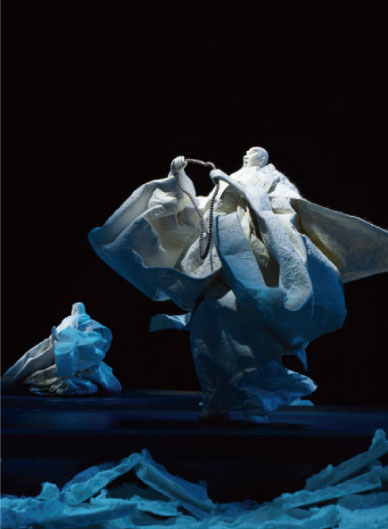
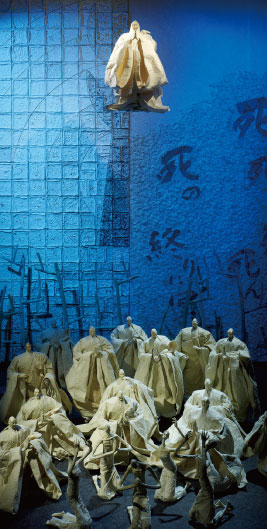
At the Ehime Prefectural Museum of History and Culture, the New Permanent Exhibition Mitsu●Sora to Umi was launched in fiscal year 2012 to present works by Uchiumi Kiyoharu, a washi paper sculptor internationally acclaimed for his outstanding artistic quality, and to introduce the life of Kōbō Daishi Kūkai. For the first three years beginning in 2012, the exhibition featured nine scenes depicting Kūkai’s life from childhood to early adulthood. From 2015, ten scenes focusing on his later years—such as the founding of Kongōbu-ji Temple on Mount Kōya—were displayed over the following three years. Since September 15, 2018, the exhibition has presented nine renowned chapters highlighting Kūkai’s achievements, including his arduous voyage to Tang China and the capital Chang’an. The works incorporate traditional washi papers from across Shikoku, such as those from Uchiko Town and Shikokuchūō City, and are enhanced by sound design and LED lighting to create an immersive atmosphere.
Biography of Uchiumi Kiyoharu
Uchiumi Kiyoharu is a washi paper sculptor, born in Tokyo in 1937. He graduated from Waseda Jitsugyo School in 1956 and from the Department of Crafts at Tokyo University of the Arts in 1965. He worked as a product designer and lecturer at design schools. In 1978, he received an award at the Japan Craft Competition organized by the World Crafts Council. Since then, he has been active as a washi doll artist. He has held nationwide touring exhibitions of his washi doll works and exhibited overseas, and has been active both in Japan and abroad, earning international recognition for his high artistic quality. He has toured nationwide with the exhibitions Kan●Heike, Mitsu●Sora to Umi, and En●Genji. In 2000, Kan●Heike was exhibited in Paris (The Japan Cultural Institute) and in the Netherlands (National Museum).
Uchiumi’s Works and Ehime
The works of Uchiumi Kiyoharu pursue sculptural spaces and narrative qualities created by arranging numerous figures on a stage. They represent a form of “new spatial art” that combines the three-dimensional element of dolls with the pictorial element of the background. Generally, display dolls are presented individually or in pairs; however, Uchiumi Kiyoharu transforms groups of washi dolls into Emakimono (illustrated scrolls), giving three-dimensional form to the dramatic qualities of illustrated narrative scrolls. By incorporating viewpoints within three-dimensional space, he seeks to expand narrative expression and create a sense of infinite breadth. The washi paper used in the works is produced in Shikoku. The faces of the dolls are made from ganpi paper from Ino, Kochi Prefecture; most of the costumes are made from kōzo paper from Ikazaki, Ehime Prefecture (Ōzu washi); the monks’ kesa robes use speckled craft paper from Kawanoe, Shikokuchūō City; and the washi tiles used in the background are made from Awa washi from Tokushima.